
🧠 The Engineer and the Biohacker
Being alive is no longer just a biological state but a design space.

While formatting our next book, How to Talk AI, I found myself thinking about two men who—each in his own way—decided that life itself was editable.
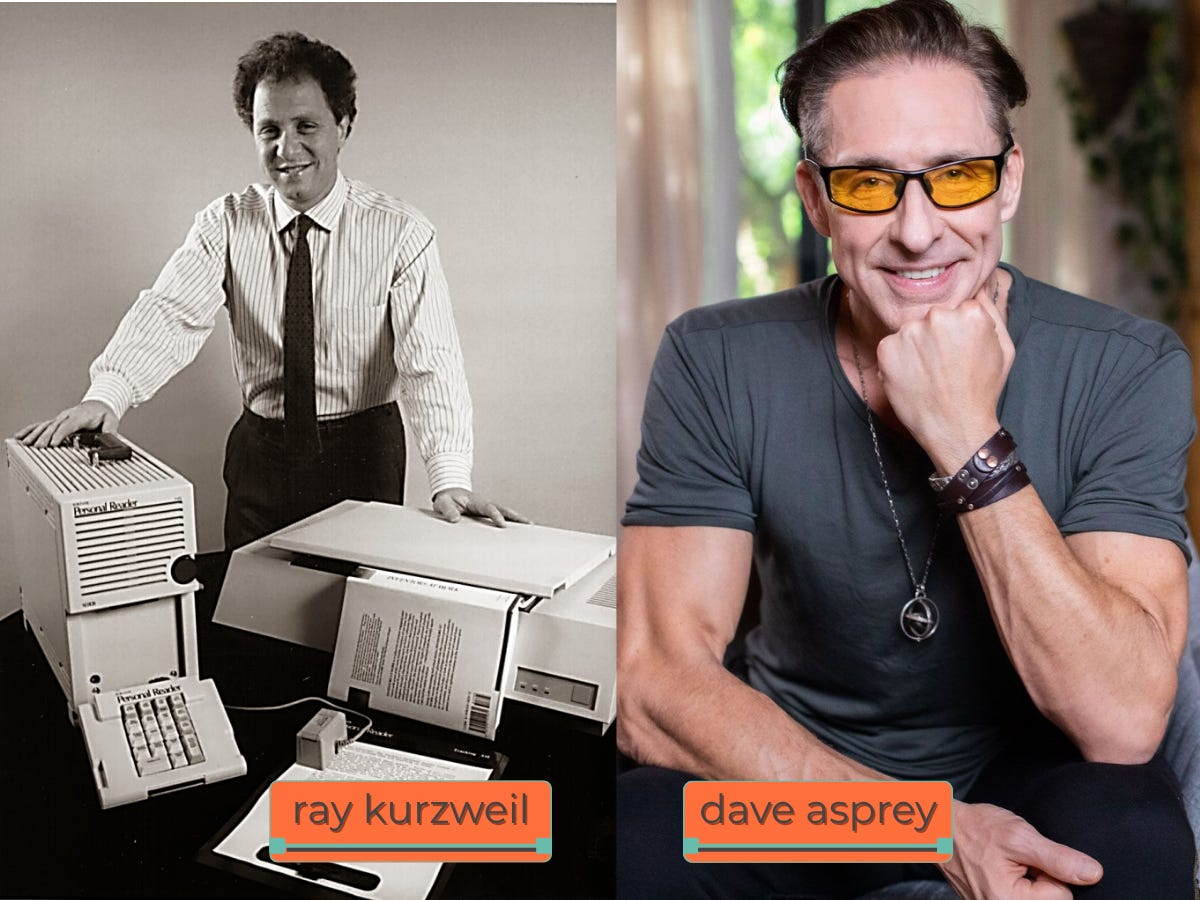
Ray Kurzweil, now 77, still works at Google, where he leads research in artificial intelligence. Long before that, he developed the first omnifont OCR—teaching computers to read any font—then created a music synthesizer that could mimic real instruments, blurring the line between human artistry and digital precision. In 1998, Forbes called him “the ultimate thinking machine.” Today he’s still publishing, still coding, still predicting that if we can stay healthy long enough, technology will outpace aging itself. His phrase for it is “longevity escape velocity.”
Dave Asprey began in the same world—writing code, scaling networks, and building the infrastructure of the early internet. After selling his first tech company, he did something very Silicon Valley: he reinvested his exit into himself. He turned the language of systems optimization inward, applying engineering logic to biology and coining a culture in the process. He’s the original biohacker, famous for saying he plans to live to at least 180 —and for taking more than 100 supplements a day to test that theory.
Two paths.
One vision: Being alive is no longer just a biological state but a design space.
I feel oddly connected to Kurzweil right now. He’s a reminder that every time I export a PDF, run a compliance audit, or ask an AI to check my margins, I’m walking on a bridge he built between human words and machine understanding. And maybe—just maybe—the same bridge will carry us all a little farther than we expected.
Inspiration meets specification. Life, like books, may soon have no hard margin at all.
⚡ Signal Boost
We’re standing at the threshold where editing text, editing code, and editing biology are starting to feel like the same act — pattern recognition with consequence. The question isn’t whether we can redesign life; it’s whether we’ll have the wisdom, humor, and humility to proofread what we create.
hashtag#PatternSignal · hashtag#HybridMind · hashtag#RayKurzweil · hashtag#DaveAsprey · hashtag#AIandCulture · hashtag#Longevity · hashtag#Biohacking · hashtag#HumanAI
Hey Dia,
There are so many sharp and "generative" threads in what you’ve shared that I don’t think the comments section can quite do them justice.
And, it’s made me even more curious and excited for our upcoming conversation.
The blur you’ve pointed to—between posthumanism and existential design—feels especially timely.
That interplay between what we build and who we become is no longer speculative. It's now woven into daily, even mundane, choices: how we interface with systems, how we shape narratives around self, and how technology reshapes those narratives in return.
And I loved that you brought up names and frames I feel I should know—until now.
That, in itself, is a form of bridge-building.
Your words also touched on something I’ve been quietly sitting with: how much of our future agency will be determined not just by the tools we adopt, but by the internal architecture we design for ourselves.
Because the real interface we’re all using—before the keyboard, before the tech—is the one between our past and potential selves. And unless we learn to design that space with more intentionality, depth, and self-trust, no external breakthrough will quite feel like it lands.